- DePIN Snacks
- Posts
- Daylight Energy Raises $75M...
Daylight Energy Raises $75M...
...to turn homes into distributed power plants that support a decentralized network.

Sal Gala
October 16, 2025
Today, our portfolio company Daylight Energy announced a $75M raise to turn homes into distributed power plants that support a decentralized network.
This marks EV3’s third investment in Daylight since 2022 and the largest investment in our first fund. We have extreme conviction that Daylight is on a path towards disrupting the energy industry while setting a new gold-standard for DePIN.
DePIN 2.0
A handful of projects invented the DePIN 1.0 model in 2019-2020, think Helium IoT and Filecoin, and were subsequently followed by projects like Helium mobile, Dimo, Geodnet and Hivemapper in 2021-2022 adopting more or less the same playbook:
Hardware “pre-sales”: early miners wait months (or years…) for v1 devices
Capped supply: miners get allocated 40-50% in total
High inflation: early miners earn the vast majority of rewards
Slow demand ramp: several years to reach $1M onchain ARR
The result of the DePIN 1.0 experiment was transformational for infrastructure economics, but not particularly efficient.
The good:
DePIN discovered a way to coordinate capital and labor in such a way to scale physical infrastructure globally 10x faster than ever before.
A meaningful chunk of that infrastructure is providing real value to customers and revenues to the protocols today.
The bad:
DePIN burnt its reputation with millions of miners and tokenholders when the underlying utility of the infrastructure we built did not meet the market’s expectations, at least not in the short term.
DePIN settled into the locally-optimal but globally-suboptimal playbook described above, with market dynamics (ie CEX listings) holding back entrepreneurs from deviating from it
Since then, the successful projects listed above have pivoted away from the basic playbook in a variety of ways, i.e. less inflation subsidies (more paid traffic), many ways to for users to contribute (not just deploying hardware), no sacred cow around "max" supply.
Daylight Energy
Daylight is inverting DePIN, pioneering what we call the DePIN 2.0 model:
Vertically integrated across financing, infrastructure, and distribution
Many ways to mine: not only deploying devices
No capped supply: long-term inflation follows real-world capex cycles
Demand from day one: iterate in private markets, scale in public markets
Unlike DePIN 1.0, Daylight is a vertically-integrated decentralized protocol. Or rather, set of protocols. As part of this raise, EV3 is investing into DayFi, an onchain financing protocol that will bring energy yields to DeFi. DayFi serves as Daylight’s integrated financing mechanism: our capital (and soon, yours) is used to finance the buildout of new solar + batteries assets at users’ homes. Users buy an “energy subscription” that’s cheaper than their current monthly electricity bill, with no downpayment required, and get the resiliency benefits of having their own personal mini power plant attached to their home.
In exchange for paying for the solar+battery deployments, DayFi depositors earn a combination of:
Homeowners paying their recurring monthly electricity payments
The utility (electricity grid) buying back excess electricity in times of deficit
The US government allows monetizing of tax credits from battery deployments (but not solar… these were recently phased out)
Corporate buyers buying solar RECs (renewable energy credits) to offset their emissions
Combined, we believe these can deliver high teens / low twenties yield to DayFi depositors.
Why does this matter for crypto?
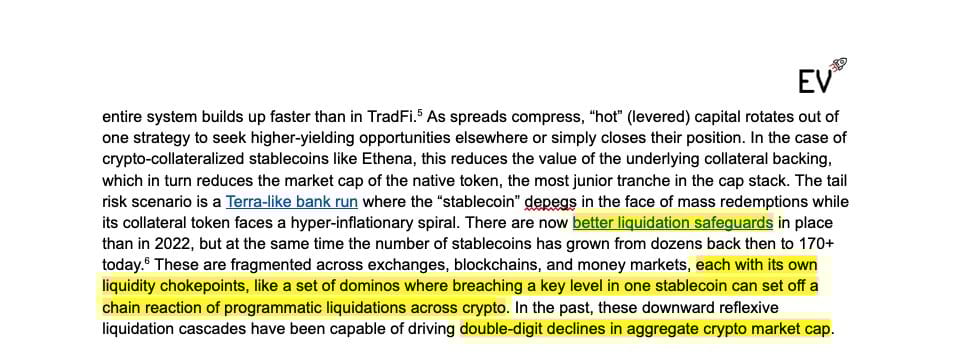
In our Q3 investor letter published Oct 2nd, we wrote about the growing risks in DeFi where an unprecedented amount of capital is being borrowed and rehypothecated across thousands of protocols and hundreds of capital. Everyone and their mother is raising a credit or yield fund, but virtually all onchain yield is generated in one of 2-3 ways: lending to leveraged traders, earning fees/spreads on trades, and, to a lesser extent, for securing PoS networks. The result: onchain yields are highly sensitive to changes in the level of onchain trading activity. Eight days later, on Oct 10, our analysis proved correct as a downward reflexive spiral led to a roughly 10% decline in crypto market cap. Like we predicted, Ethena’s safeguard held up, but the fragmented nature of liquidity caused USDe to depeg on large exchanges.
Our next prediction will also come true: new types of uncorrelated yields will become available onchain and serve as a “relief valve” for yield-seeking onchain capital when trading volumes decelerate. Soon, users will be able to deposit funds into DayFi and earn higher yields than stablecoin looping today lending to real-world assets that historically are extremely low credit risks .

How can I join the network?
Go to https://start.godaylight.com. If you live in Illinois or Massachusetts, you can get solar + battery installed on your home today by Daylight at zero-up front cost, reduce your monthly energy bill, and have a guaranteed power backup in the case of climate emergencies or grid outages. If you have friends or family living in those states, you can earn Sun Points (and network tokens in the future) for referring them to Daylight. If you don’t live in those states, we are rolling out 10+ states next year and will notify you when we can serve your area.
Daylight is a rocket ship based in NYC that just raised $75M to scale a new type of energy infrastructure at the edge. Email me if you’re interested in any of their open roles:
DeFi strategist
Protocol engineer
Senior blockchain engineer
Senior backend engineer
Senior brand designer
Energy storage analyst