- DePIN Snacks
- Posts
- State of DePIN 2025: The Resurrection
State of DePIN 2025: The Resurrection
DePINs generated $72M revenue in 2025 amidst the crypto bear market.

Sal Gala
January 28, 2026

When we started EV3 in 2022, the most common reaction to the DePIN thesis was a simple "De-what? What's that?". Today, we're more likely to hear "DePIN is dead."
DePIN went from unknown, to idolized, to dismissed—its first full cycle. The OG class of DePINs you've probably heard of are trading down 94-99% from their all-time highs. Aggregate DePIN market cap fell -80% in 2025, from $50B to $10B.
With skeptics taking victory laps, we have never been more excited about the future of the space. DePIN is an inevitable global movement. Today, we are releasing EV3's annual State of DePIN 2025 report alongside our friend Dylan Bane from Messari. You can read the full 60-page report here: https://messari.io/report/state-of-depin-2025

State of DePIN 2025
The DePIN Thesis: What Did We Get Right?
Many of the theories we had about DePIN back in 2021 were proven correct, and now have a cycle's worth of data to support them. But investors' attention spans are limited: with token prices in decline, very few people are paying attention to the economic fundamentals of the leading DePINs. Namely, we correctly predicted that:
DePINs would scale to global coverage faster than web2 competitors
Large enterprises would be willing to pay for DePIN-powered services
Miners would earn competitive returns from paid usage vs incentives
DePIN revenue growth would be more resilient than both DeFi and L1s
DePIN's true potential would be unlocked only with DeFi composability
The proof is in the pudding. Helium connected 1M IoT hotspots. Geodnet covers 80% of populated areas of the earth. Hivemapper maps 37% of global roads. Each of those supply-side buildouts happened in less than two years. It's not easy, but there is a clear path to global infra buildouts via DePIN.
On the demand side, enterprise demand for DePIN services is exploding. We believed that DePIN's advantages in cost, scale, and speed of supply-side buildouts would entice demand from the world's largest companies. We were correct. Today, the biggest telcos - AT&T and T-Mobile - pay Helium >$1M per month to offload customer traffic onto WiFi hotspots. The biggest ridesharing companies - Grab and Lyft - buy mapping data from Natix and Hivemapper to improve logistics, and the biggest automotive companies - Valeo and Volkswagen - buy video data from them to train autonomous vehicles. The world's leading AI labs paid Grass $13M in Q4 to scrape and index the public web. Farmers, factories, and fleets paid Geodnet $1.4M in Q4 to enhance accuracy of their GPS sensors. These are only the customers that have been publicly disclosed—behind the scenes, many more large enterprises are renting resources from DePINs at scale. The fact that DePIN has utility for enterprises is no longer an open question.
When it comes to unit economics, we predicted that DePIN miners would earn strong returns from paid usage - without the need for incentives - and therefore that DePIN networks themselves would approach net deflation. Again we were proven correct. In 2021, buying and deploying a Helium miner paid for itself back in 2-3 weeks, with >99% of the economics coming from inflationary token subsidies (proof of coverage). Today, average paybacks are a more sustainable 6-12 months, with virtually all rewards coming from paid usage. Rewards have entirely shifted from incentives, which go to all miners regardless of usage, to utility, where only the miners providing value to the network get paid. This has caused a healthy increase in dispersion: the top percentile of miners makes 1000%+ IRRs while the bottom decile earns a negative IRR. With real demand, there is no longer any incentive to put up hotspots in places where they will not get used—and as a result, Helium's network has become massively more efficient.
In web2 terms, DePINs are effectively marketplaces that connect large enterprise customers with small- and medium-sized infrastructure operators. Like most web2 marketplaces, DePINs take on some inventory risk; but unlike web2 marketplaces, inventory (supply) is paid for token dilution rather than cash. Once DePINs are at scale, supply tends to be sticky and a relatively fixed cost, while demand growth can compound exponentially and eventually surpass the infrastructure costs demanded by miners to keep their hardware running. At this point, DePINs become a profitable marketplace and earn an economic rent for connecting enterprise demand with fragmented long-tail suppliers or deployers of infrastructure.
Helium went from 10% inflation to deflationary (profitable) in 2025. Geodnet is two-thirds of the way there, with 66% of token inflation offset by demand-side driven burns. Deflation means that every year you hold your HNT, there are fewer tokens in circulation, and stable or growing demand to transfer data over Helium's network. Every year, your tokens are worth more.
We predicted that DePIN revenue growth would be more resilient than DeFi and L1s—and were proven correct. While the entire crypto alts market got slaughtered this year, only the leading DePINs were able to meaningfully grow revenues in dollar terms. Helium grew onchain revenues by +4x (+9x if you count offchain revenues) and Geodnet by +3x in 2025, despite token price falling -77% and -41% respectively. DeFi tokens like Uniswap, Ethena, Aave, and Pendle saw similar token price declines and their revenues were down between -27% and -70%. Given the empirical evidence of this cycle, we hope/expect crypto investors will start thinking about revenue quality and reflexivity before comparing DePIN valuation multiples to DeFi or L1s.

We predicted that DePIN's true potential would be unlocked by tapping into the 24/7 global capital markets of DeFi. Here, we were only half right. DePIN's v1 architecture - infrastructure buildouts financed and coordinated through inflation of a single, equity-like (not a lawyer) utility token - proved suboptimal. The capital structure was too rigid, and too expensive. The right way to infrastructure is low-cost debt, or leverage, and a new iteration - or transformation - of DePIN is an architecture we like to call InfraFi. Instead of using a token to finance infrastructure deployments directly, InfraFi uses tokens to incentive stablecoin lenders to provide liquidity that is then used to finance buildouts. The InfraFi model comes with its own set of challenges - duration, credit, and principal agent problems - but its the first principles correct way of financing a global infrastructure buildout.

DePIN Isn’t Dead—It’s Just Cheap.
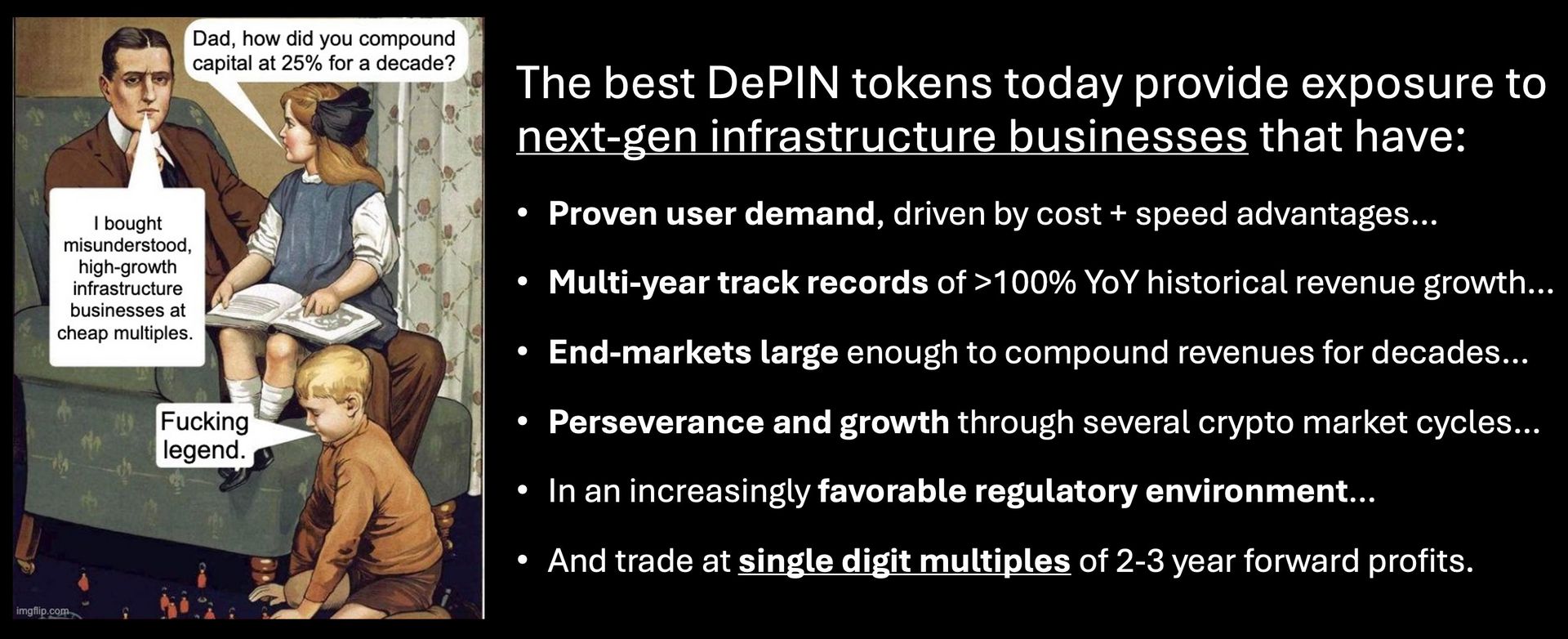
For DePINs that managed to grow revenues through the bear market, declining token prices has led to a massive decline in valuation multiples. Geodnet and Helium now trade at 11x and 25x multiples of run-rate onchain revenue (token burn), while growing tripling or quadrupling revenues YoY. If these networks sustain their current growth rates, GEOD and HNT will trade at a sub 3x multiple of onchain revenues by December 2026. 3x!! There is no company on earth trading at those types of growth-adjusted multiples.

Investor psychology is a funny thing. Back in 2021, VCs, hedge funds and traders valued assigned multi-billion valuations to DePINs with no profits, no revenue, and no users. Today, DePINs have a multi-year track record of happy customers, growing revenues, and sustained profits through all types of market environments... and yet they trade at rock-bottom multiples. At the current valuations, either DePINs stop growing revenues, or the market will re-rate DePIN tokens meaningfully upwards—there is no third path.

The best returns are made being an optimistic in times of mass pessimism. At EV3, we are excited to continue doubling down on DePIN and investing in visionary founders with the ambition to build a new generation of global infrastructure. Learn more about us on our website: https://ev3.xyz